Monday, December 15, 2014

Book Review: A Guide Book of United States Coins Professional Edition

Speaking of Red Books as we did yesterday, I did not know this "Professional Edition" existed. I found out about it because I was reading back issues of The Numismatist. 

Let me quote from the introduction:

Its combination of more photographs, detailed higher-grade valuations, listings of additional varieties and rare early Proof coins, certified-coin population data, auction records, and other resources provides a wealth of information on every coin type ever made by the U.S. Mint. The Professional Edition is not an exhaustive study of die varieties, though it does expand (with close-up photographs, valuations, and chart notes) on the regular edition’s coverage of such coins. Rather, it is a handy single-source guide that educates its users in auction and certification trends, retail valuations, and similar aspects of the marketplace.


I bought the digital edition as I do with almost books where I have a choice.  This, however, is a case where I'll recommend that you buy the physical book.

It's not that the digital edition is badly formatted - that's actually done well. It's that the mintage and pricing tables are done as pictures that are somewhat fuzzy and do not zoom well.  These are probably much easier to read in the print edition.


That quibble aside, the content is excellent. This goes into much more detail than the traditional Red Book, though I do have to ask why publish both? There are unlikely to be many extra sales - I would think that, going forward, people will buy one or the other, not both.

The 5th edition shown here didn't cover Colonials, Tokens or Modern Commems - neither does the 6th edition (available now).  It seems odd to leave those out.


Note:  All my coins are in a safe deposit box.  I keep nothing in my home. 

Sunday, December 14, 2014

The Whitman "Red Book"

I bought my first Red Book ("A Guide Book of U.S. Coins" ) in 1956 and bought them every year from then up to 1977.  I have only 9 of those now; less than half.  The rest went missing over the years, lost or given away.

Those I still have vary in condition from almost new to quite worn.  Some seem almost untouched, others are nearly ready to fall apart.

A few years ago Whitman started publishing the prices of old Red Books in the current editions.  It's Appendix B in my 2014 book and I noted that most of these are not worth very much.

However, that doesn't mean that they are easy to find.  I searched Amazon and was not able to find any of the earlier dates at all and not very many even in the 60's and 70's.

By the way, if you want to search there, I found this works well:  

"GUIDE-UNITED-STATES-Illustrated-Catalog coins"


The first Red Book is dated 1947 and only 18,000 were printed.  My 2014 book (which I bought in the digital Kindle edition) says it is worth $300 - $1700 depending on condition.  That's a bit out of my price range, but in 2006 Whitman published a "Redbook Commemorative Guide Book of United States Coins" reprint of it. I bought one of those for $15.00.


It's fun to look through the older books, but not so much fun that I'd want a complete set as this guy did: "A Complete Collection of U.S. Coins Red Books"


Note: All my coins are in a safe deposit box. I keep nothing in my home.


Friday, December 12, 2014

Why was there a Type II Standing Liberty Quarter?

If you are familiar with the Standing Liberty Quarter, you've probably heard the story about how a prudish and outraged citizenry caused the Mint to cover up Liberty's bare breast. Here is "The Bare-Breasted Liberty Quarter " telling the tale:
McNeil was obliged to modify his design. Miss Liberty would need to be properly covered, according to the citizens of our enlightened nation. It is easy to imagine that McNeil might have been a little resentful about the modification chore he had to undertake. Rather than simply rearrange the drapery on Liberty's shoulder to cover the offending breast, he crafted a suit of armor instead, and chastely clothed Miss Liberty nearly to the neck in chain mail!
I have no doubt that there were outraged citizens - there always are. In my own home state of Massachusetts, we had the Watch and Ward Society object to the bare breasted figure on the 1896 $5 Silver Certificate, so of course they didn't like this either.


However, the public outcry may not have been the impetus and McNeil wasn't necessarily resentful because of the change. If anything, he may have been resentful of the Type I design because it was a modification of what he had submitted! David Lange makes the case for that in the "Mystery of the 1917 Quarters" link below, asserting
.. the Type 1 quarters of 1916-17 were the Mint's alteration of MacNeil's design and that the Type 2 issue was a restoration of MacNeil's original concept
Or it may have had to do with World War I. The Wikipedia article on this coin mentions that Ray Young suggested in a 1979 Coins Magazine article that the redesign "came from the symbolism. If Liberty was going to stand up to her foes, she should do so fully-protected—not 'naked to her enemies.'"

Whatever the reasons, the Standing Liberty Quarter is a beautiful design.

References:
Watch and Ward Society
1896 $5 Silver Certificate
Silver Certificates
THE MYSTERY OF THE 1917 QUARTERS
Wikipedia Standing Liberty Quarter


Note: All my coins are in a safe deposit box. I keep nothing in my home.


Thursday, December 11, 2014

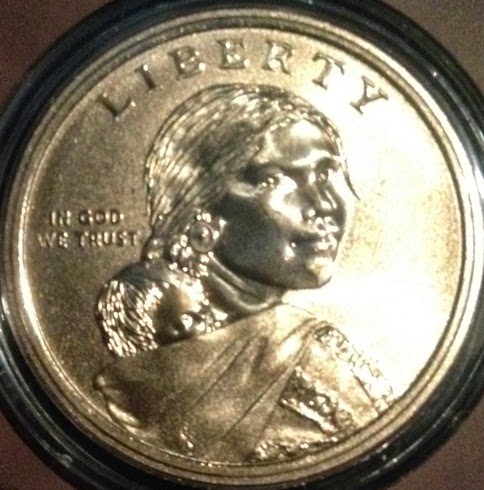
2014 Native American Enhanced Uncirculated Sacagawea

As Lou Golino explained at a recent column, the 2014 Native American Coin and Currency Set contained a small surprise for collectors: the Sacagawea dollar has the same "Enhanced Uncirculated" finish as the 2014-S Kennedy in the 50th Anniversary set and the 2013-S enhanced uncirculated American Silver eagle.

This has caused a bit of a rush with collectors and eBay prices have jumped to $30 or so (issue price from the mint was $13.95).

The coin does photograph well:


However, in hand the effect is far less dramatic than it is on the Kennedy half. That's probably due to the color and the smaller size rather than any production difference.

As to the set itself, baffling is the only word that comes to mind.  Why a crisp 2013 dollar bill is included is confusing both as to the date and its absence of relevance. 

More disturbing is the literature enclosed, which "Honors Native American hospitality that ensured the success of the Lewis and Clark Expedition", according to the Mint.  If someone would like to explain to me how the Lewis and Clark expedition helped Native Americans, I'm all ears. The  honoring of Native American history by commemorating the first stage of the expansion that would strip them of their land, their dignity and their way of life is really a head shaker.

Note:  All my coins are in a safe deposit box.  I keep nothing in my home. 


Wednesday, December 10, 2014

Canadian Bison Bullion coin

I don't even remember entering this contest ( https://www.cointalk.com/threads/ive-got-a-new-2015-1-25-oz-canadian-silver-bison-and-im-giving-it-away.255609/ ) but I was picked as the winner. By the way, CoinTalk.com forums are well worth visiting anyway, but they do run frequent contests, so that's another good reason to visit.  

At first I thought the coin was a piece of private bullion, but no, it's from the Royal Canadian Mint. It's distributed in the U.S. by J.M. Bullion and you can read all about it here: http://www.jmbullion.com/bison/

It's an interesting coin. First, the weight: 1.25 ounces.  It's the same diameter as a Silver Maple Leaf, but gets its extra weight from being 25% thicker at 4.1125 mm.   There are "anti-counterfeit radial lines" running through the obverse and reverse fields, also.

The reverse is very attractive:


The obverse, not so much:


These are 38 mm coins,  but thicker than silver dollars and bullion coins:


I'm not sure why they decided to go with the 1.25 ounce weight. The nominal $8 value is odd also as they make 1 ounce bullion with a $20 face value.


Note:  All my coins are in a safe deposit box.  I keep nothing in my home. 


This text was recognized by the built-in Ocrad engine. A better transcription may be attained by right clicking on the selection and changing the OCR engine to "Tesseract" (under the "Language" menu). This message can be removed in the future by unchecking "OCR Disclaimer" (under the Options menu). More info: http://projectnaptha.com/ocrad

Tuesday, December 9, 2014

Book review: A Guide Book of Civil War Tokens by Q. David Bowers (Digital edition)

Although technically exonumia, both Hard Times and Civil War tokens circulated as money during times when official coinage was scarce. This makes them more interesting to collectors than they might have been otherwise.

Because all of these were completely unofficial, there is a wide variety of designs and also a great number of mixed obverse and reverse dies. For example, there are two dozen or more pages of tokens that look very much like this.


All of that means that it is certainly possible to discover an unknown type that never reached wide circulation. Even without that, these are fascinating and generally inexpensive to collect.

This book catalogs many tokens of this period. The color images are good quality and will expand to full page when you "pinch out", allowing you to fully examine details. This book is NOT just pictures of tokens with rarity estimates and values - there is a large amount of history and explanatory text also.

The only complaint I can make at all is that not all die pairings are shown, but of course if they were, the book would be even larger than it is.


This is much more than a "coin book". I'd recommend to anyone with an interest in history and of course it is particularly relevant to the Civil War period.


Because of the ability to zoom photos, I would suggest the digital Kindle version. Note that you do not have to own a Kindle; Amazon provides free Kindle readers for Windows, Mac, Ipads, Android and more.


Buy this book at Amazon and help me support this site!


Note:  All my coins are in a safe deposit box.  I keep nothing in my home. 

Monday, December 8, 2014

The PCGS Sniffer shows up in a TrueView

I asked for Secure Service on the last group of coins I submitted to PCGS. I didn't really need it as these were just $5 Baseball Hall of Fame Gold proofs, but I like the label.  Honestly, I'd like to do all of my collection with that and PCGS True View.  That would be a fair outlaw of cash, but maybe I can swing a few at a time.


Anyway, one of the Secure photos came back looking like this.


PCGS explained

Secure images get cropped automatically via software, sometimes it doesn't work as it should. Our IT department) can go in and crop it manually. If anyone sees an error such as this let us know the cert number and we'll fix it. 
So what we are seen there is the "sniffer".   There's an odd video that shows how that works.  I say it is odd because the woman handling the coin is not wearing gloves.  I hope that's just because it is a demonstration!

You can see  more examples of confused cropping at Collectors Universe Forums - The inside of the Secure Plus scanner.

I actually think it's kind of cool :)


Note: All my coins are in a safe deposit box. I keep nothing in my home.